





Collaboration for Change, The Edge Commission Report on the Future of Professionalism
The Edge is a multi-disciplinary think tank that works on issues that impact on the built environment. It promotes collaboration between the disciplines and an evidence-based approach to design and problem solving.
In 2014 the Edge invited Paul Morrell, ex-Government Chief Construction Advisor to chair a Commission of Inquiry into the future of professionalism in the construction industry. The Commission published a report on 18 May 2015, Collaboration for Change, The Edge Commission Report on the Future of Professionalism.
In the foreword, Morrell says. "The questions that the professions face are not, for the most part existential, but rather evolutionary. What is of value will remain, but both the context and terms of trade will change as the professions adapt to keep themselves relevant to the needs of successive ages... if there is a single message, it is that their future will be more successful if addressed collectively."
The report suggests that the institutions continue to perform a valuable role in areas such as; setting standards of competence and conduct, setting standards and frameworks for education, regulating members, improving the standing of members, providing industry leadership and serving the public interest. However, it also identifies threats and pressures for change faced by the institutions and their members, suggesting that they can be seen as protectionist, resistant to change and perpetuators of unhelpful ‘silos’ and hierarchies.
The report proposes that the authority of the institutions would increase exponentially if they presented a shared view, and it identifies areas where they could act together to increase their relevance and value:
- Ethics and the public Interest.
- Education and competence.
- Research and a body of knowledge.
- Collaboration on industry reform, climate change and building performance.
It points to a confusion between 'ethics' and 'public interest', and proposes clarifying and codifying a shared understanding of expectations at individual, corporate and institutional levels and moving from a tendency to exclusivity centred on members’ interests to one of inclusivity centred on the public interest.
The report also highlights the importance of establishing a working body of knowledge, and of disseminating research and best practice, suggesting that the institutes might establish a joint think tank, to conduct, develop, curate and disseminate research and develop policy. This it describes as a 'King's Fund for the built environment' referring to the independent charity working to improve health and health care in England. The report points to the proceedings of the ICE and the CIBSE Guides as examples of well researched and widely disseminated bodies of knowledge that could be emulated by other institutes.
At the launch event, held at Arup's offices in London, Morrell warned of the "death of deference", whilst Lord Deben (John Gummer, Chairman of the Climate Change Committee and previous Secretary of State for Environment) spoke passionately about the need for professionals to turn down projects likely to perform badly, suggesting that having standards requires that we sometimes say no.
In the press release accompanying the launch, Sean Tompkins CEO RICS said, “The title of the Edge Commission’s Report: “Collaboration for Change” neatly encapsulates the challenge facing professions today. If professions are to remain relevant in an ever more interconnected and technologically advanced world, they will need to work together more closely.”
Chris Blythe, Chief Executive CIOB said, “The recommendations in the report highlight that change is almost impossible without industry-wide collaboration, cooperation and consensus and the professions and other key institutions can lead the way in ensuring that this collaboration is in the public interest.”
[edit] Find out more
[edit] Related articles on Designing Buildings Wiki
Featured articles
Check out some of the best features and news from Designing Buildings as well as key stories from around the web.
Leaders in Learning for Practice Network
Call for conservation leaders in learning to register interest in new network.
The importance of early engagement

Construction lessons from the Trillium HealthWorks Experience Centre.
Mayors are to be given planning call in powers

Mayors across England will be able to make the most important planning decisions.

The Master Builder: William Butterfield and his times. Book review.

Why construction can't afford to ignore the skills gap.
Building Safety Regulator, 19 August

Gill Kernick appointed Independent Chair of Residents’ Panel.
Connecting knowledge, technology and conservation
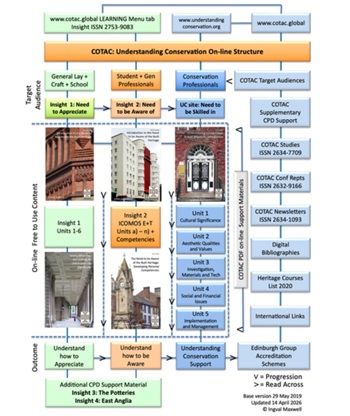
Building competence for the future of built heritage.
Building Regulations and Building Safety Act
CIOB publishes free advice for non-domestic clients.
Building Safety Newsletter from MHCLG.

An extraordinary record of steel engineering worldwide.

Households living near new pylons to save on bills.

ECA warns growth must not outpace grid capacity or skills.